How Does MAXEN Manufacture TFT LCD Modules In-House?
In-house LCD module manufacturing connects approved display designs with the production processes required to build finished TFT LCD modules. After sample approval and order confirmation, MAXEN prepares the applicable materials, manufacturing instructions, and production arrangements according to the agreed product configuration.
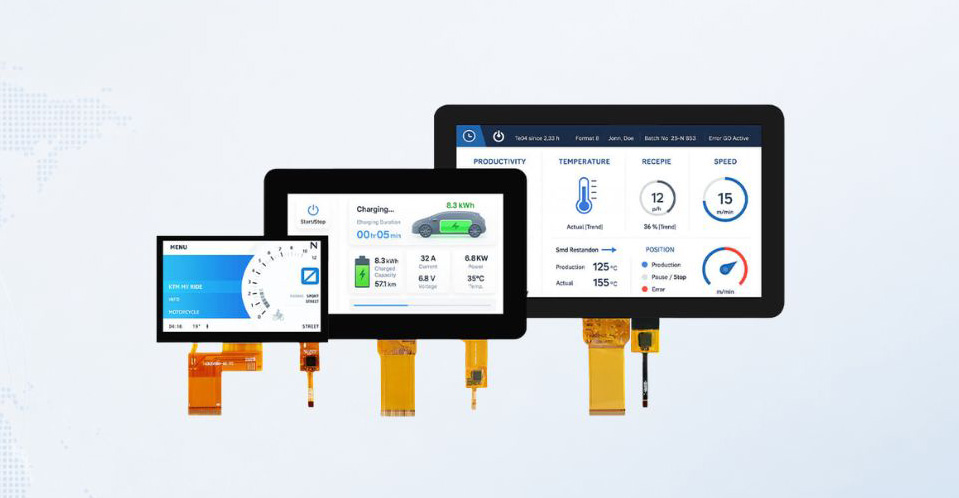
Our LCD manufacturing capabilities cover mother glass cutting, backlight engineering, COG/FOG bonding, and LCD module assembly. Depending on the project, production may also include customized FPC configurations, touch panel processing, and optical bonding.
These manufacturing operations allow MAXEN to support both standard TFT LCD modules and customized display assemblies. The actual production route depends on the LCD panel structure, selected components, and approved specifications. Not every module requires every manufacturing process described below.
Approved Design and Production Preparation
Manufacturing begins with a confirmed product configuration and the commercial arrangements required to release the production order. The approved LCD model, technical drawings, material specifications, and applicable customer requirements provide the reference for production preparation.
For standard TFT LCD modules, established product specifications and production arrangements are used to prepare the required materials and manufacturing activities. Depending on the order, the team may need to confirm component availability, production quantities, and delivery schedules before starting the manufacturing run.
Customized LCD projects require additional attention to design revisions. Approved engineering drawings may define modified FPC dimensions, connector locations, backlight configurations, touch structures, or other product-specific features.
MAXEN coordinates relevant production information so the applicable manufacturing teams work from the intended product configuration. This is particularly important when a customized module resembles an existing standard product but contains different electrical or mechanical details.
Material preparation may involve LCD panels, driver ICs, FPCs, LEDs, optical films, backlight components, connectors, touch panels, and cover glass, depending on the module structure.
Some components are sourced from upstream manufacturers, while MAXEN performs the applicable cutting, bonding, assembly, and integration operations within its manufacturing scope.
Manufacturing preparation also considers the sequence of operations. LCD panel preparation, backlight assembly, and touch component processing may be organized as separate activities before their corresponding components are integrated.
The objective is to establish a consistent production reference before materials enter the relevant manufacturing stages.
LCD Mother Glass Cutting and Panel Preparation
Mother glass cutting is one of the manufacturing operations used to prepare LCD panels for subsequent module assembly.
MAXEN processes large-format LCD mother glass supplied by upstream panel manufacturers, including established LCD panel suppliers. The cutting operation separates the prepared mother glass into the required display dimensions according to the applicable panel layout and manufacturing specifications.
This process should be distinguished from manufacturing the original TFT glass substrates or fabricating the liquid crystal panel structure. MAXEN's mother glass cutting capability concerns the preparation of supplied LCD glass for module manufacturing rather than the upstream fabrication of TFT arrays.
Accurate cutting and handling are important because LCD glass contains delicate structures that can be damaged by improper mechanical stress, contamination, or handling.
The cutting arrangement depends on the supplied glass structure and the dimensions of the intended display. Appropriate positioning and process settings are necessary to obtain the required panel format while protecting sensitive areas.
Following cutting, applicable cleaning and preparation operations help remove particles and residues that could interfere with downstream processes.
Prepared LCD glass may subsequently undergo operations such as driver bonding, FPC connection, and module assembly, depending on the product design.
For customers, the practical value of this manufacturing capability is that glass preparation can be coordinated with the subsequent LCD module processes.
However, cutting capability does not mean that every display size or resolution can be created from any available mother glass. The achievable configuration remains dependent on the original panel design, available glass layout, and technical feasibility.
LED Selection and Light Bar Engineering
Backlight engineering is an important part of MAXEN's manufacturing capabilities, particularly for LCD modules requiring customized brightness, power consumption, or optical characteristics.
Unlike self-emissive display technologies, conventional transmissive TFT LCD modules rely on a backlight to illuminate the liquid crystal panel.
The backlight light source, optical structure, and electrical driving conditions influence the final display's brightness, uniformity, energy consumption, and thermal behavior.
MAXEN supports in-house LED light bar design and backlight configuration according to the requirements of applicable LCD modules.
LED selection may consider luminous output, electrical characteristics, color properties, thermal behavior, and the space available within the backlight structure.
For applications requiring higher display brightness, engineers may evaluate the LED arrangement and light bar configuration together with the driving requirements and optical components.
The LED light bar must be compatible with the available power supply and backlight driving circuit. Increasing LED output can increase electrical power requirements and heat generation, making thermal considerations important during design and manufacturing preparation.
Customized light bar layouts may also need to account for the dimensions of the light guide, mechanical support structure, and available installation space.
MAXEN's engineering work focuses on LED selection, light bar configuration, and backlight integration. This does not imply that MAXEN fabricates the semiconductor LED chips themselves.
By coordinating LED light bar design with backlight assembly, MAXEN can evaluate suitable configurations for standard industrial modules, high-brightness displays, and other project-specific requirements.
The final performance depends on the complete backlight structure, its driving conditions, and the selected LCD panel.
Optical Film Configuration and Backlight Assembly
TFT LCD backlight unit contains more than LED light sources. Its optical and mechanical components work together to distribute light across the display area and support the intended brightness characteristics.
Depending on the backlight design, the assembly may include LED light bars, light guide plates, reflector materials, diffuser films, brightness enhancement films, and supporting frames or bezels.
In an edge-lit backlight, light enters the light guide plate from LEDs positioned along the edge. The light guide structure and optical films help distribute and direct illumination toward the LCD panel.
Diffuser films help reduce visible brightness irregularities, while brightness enhancement films can redirect light to improve luminance within particular viewing directions. Reflective materials help redirect otherwise lost light back into the useful optical path.
The selection and arrangement of these materials depend on the required brightness, module dimensions, viewing characteristics, and mechanical design.
During backlight assembly, components are positioned according to the applicable structure and manufacturing instructions. Film orientation, component alignment, cleanliness, and mechanical fit are important considerations.
Incorrect positioning or contamination can result in visible optical irregularities after the LCD module is assembled.
For customized projects, MAXEN may evaluate changes to LED light bar arrangements, optical films, or supporting backlight structures to meet agreed performance requirements.
A high-brightness design must consider optical performance together with electrical power and heat generation. Higher LED output alone does not guarantee that a completed display will meet the intended application requirements.
Once the required backlight components have been assembled, the backlight unit can be prepared for integration with the corresponding LCD panel.
This in-house backlight assembly capability supports greater coordination between optical configuration and LCD module manufacturing.
Chip-on-Glass (COG) Bonding
Chip-on-Glass (COG) bonding is an important process for TFT LCD module configurations that use driver ICs mounted directly on the LCD glass.
The display driver IC controls the electrical signals required for image formation. In a COG structure, the driver IC is attached to the designated connection area on the glass panel rather than mounted on a separate conventional circuit board.
This arrangement can support compact LCD module designs, but it also requires accurate positioning and reliable electrical connections.
COG bonding commonly uses anisotropic conductive film (ACF), a bonding material that enables electrical connection between corresponding contact points while helping maintain insulation between adjacent connections.
During the bonding operation, the driver IC must be aligned with the appropriate contact pads on the LCD glass. The applicable bonding conditions depend on the IC design, contact geometry, ACF material, and LCD panel structure.
Temperature, pressure, and bonding time are important process variables because they influence the formation and stability of the bonded connection.
Improper alignment or unsuitable process conditions may cause connection defects that affect display functionality.
MAXEN's COG bonding operations support applicable LCD module configurations requiring this type of driver connection.
Process preparation includes identifying the correct glass panel and driver IC configuration, along with the relevant bonding requirements.
After bonding, the applicable connection and assembly characteristics are checked before the module advances through subsequent manufacturing operations.
Not every TFT LCD module uses the same driver packaging method. The bonding structure depends on the panel design and selected components.
By carrying out applicable COG bonding operations in-house, MAXEN can coordinate driver attachment with LCD panel preparation, FPC connection, and later module assembly.
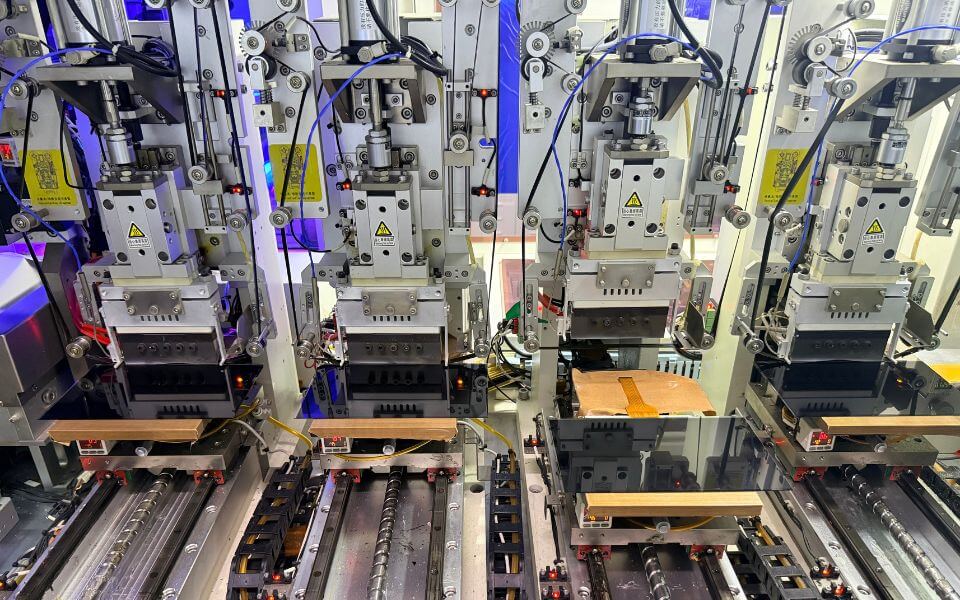
Film-on-Glass (FOG) Bonding and FPC Connections
Film-on-Glass (FOG) bonding establishes the connection between the LCD glass and the corresponding flexible circuit or film connection structure.
The flexible printed circuit (FPC) provides an electrical path between the LCD module and the equipment's host electronics. Its connection to the display glass must be compatible with the electrode layout and mechanical design of the module.
MAXEN operates FOG bonding equipment for applicable TFT LCD module manufacturing.
Before bonding, the relevant glass contact area and FPC connection area are prepared according to the product's process requirements. Correct orientation and alignment are essential, particularly when the connection involves closely spaced contacts.
ACF is commonly used in this type of connection. Under the appropriate bonding conditions, it helps establish electrical continuity between corresponding contact points while maintaining separation between adjacent circuits.
The operation requires controlled alignment, bonding temperature, pressure, and time according to the selected materials and module structure.
For customized LCD projects, FPC design can be an important part of the manufacturing configuration. Customers may require modified cable lengths, connector positions, FPC exit directions, or routing geometries to suit their equipment.
These changes must remain compatible with the electrical interface and the physical connection arrangement at the LCD glass.
A customized FPC does not simply need to fit the enclosure. Its electrical layout and bonded connection must also remain suitable for the selected display configuration.
After FOG bonding, the connected assembly proceeds through the applicable stabilization, inspection, or subsequent manufacturing operations.
The integrity of the glass-to-flex connection is important because defects in this area can affect image output, signal transmission, or module operation.
MAXEN's in-house FOG bonding capability supports coordination between approved FPC designs, glass bonding requirements, and LCD module assembly.
LCD Module (LCM) Assembly
LCD module assembly brings together the prepared LCD panel, backlight unit, FPC connections, and applicable supporting components to create a functional display module.
The exact assembly structure varies according to display size, mechanical design, driver configuration, and product requirements.
A typical transmissive TFT LCD module includes an LCD panel and a backlight assembly. Depending on the design, additional structural components may include supporting frames, bezels, protective materials, or other elements required for mounting and integration.
During assembly, the LCD panel and backlight must be positioned correctly so that the active display area aligns with the intended illuminated area.
Mechanical alignment is important because displacement, pressure, or interference between components may affect appearance, optical uniformity, or physical fit.
Handling requirements also matter. LCD glass, polarizer surfaces, FPCs, and exposed connection areas can be sensitive to contamination, scratches, bending, or excessive force.
MAXEN assembles LCD modules according to the applicable product drawings and manufacturing instructions.
For standard TFT LCD products, established assembly configurations provide the reference for the manufacturing process.
For customized products, the assembly must reflect approved changes such as backlight structure, FPC routing, connector placement, or module dimensions.
When a project requires touch functionality, the resulting LCD module may also be prepared for integration with a separately manufactured touch panel or cover glass assembly.
The completed LCD module represents the integration of several manufacturing operations rather than a single assembly activity.
Applicable functional and appearance checks help identify issues that may arise during integration. More detailed production inspection, aging requirements, and outgoing quality procedures are addressed in the following quality control stage.
Touchscreen Integration and Manufacturing Control
Beyond standalone TFT LCD modules, MAXEN also supports touch panels and integrated touchscreen displays. These products may require additional component preparation, touch controller integration, cover glass processing, and optical bonding.
A touchscreen display combines technologies with different manufacturing requirements. The LCD module produces the image, while the touch panel detects user input. Where required, a cover glass provides the front surface, and optical bonding integrates the display and touch structures.
MAXEN coordinates the applicable manufacturing operations according to the approved product configuration. Standard modules and customized assemblies may follow different process routes, component requirements, and production arrangements.
Capacitive Touch Panel Preparation
Projected capacitive (PCAP) touch panels use transparent conductive sensing structures to detect changes associated with touch input.
Depending on the selected design, a capacitive touch panel may include a transparent sensor structure, cover glass, FPC, touch controller connections, and adhesive or bonding layers.
MAXEN supports capacitive touch panel processing and integration for applicable touchscreen projects.
Touch panel preparation may involve cutting, cleaning, drying, component positioning, and lamination operations according to the selected construction and manufacturing requirements.
Glass handling and surface cleanliness are important because contamination, scratches, or alignment problems can affect the appearance and assembly quality of the finished touch panel.
The sensor structure and electrode arrangement determine the electrical characteristics that must be supported by the touch controller and its connection circuit.
Touch panel dimensions must also correspond to the intended active touch area and the mechanical requirements of the customer's equipment.
For projects involving customized touch structures, component preparation may require coordination between sensor dimensions, FPC location, cover glass design, and final assembly thickness.
Not every touch panel uses the same sensor construction or manufacturing process. The applicable preparation route depends on the approved configuration and the source and condition of the components supplied for assembly.
For customers, this manufacturing capability supports integration of the touch function with the selected LCD module rather than treating the display and touch panel as unrelated components.
Touch Controller and Cover Glass Configuration
Touch controller integration is an important part of preparing a complete capacitive touchscreen assembly.
The touch controller processes the signals from the touch sensor and communicates touch information to the host system. The controller configuration must be compatible with the sensor design and the intended electrical interface.
Depending on the project, the connection may use an interface such as I2C or USB. The specific controller and communication method depend on the approved touch panel configuration.
MAXEN supports touch controller selection and integration requirements for applicable customized touchscreen projects.
The touch FPC may also need to match the customer's connector position, installation space, or mechanical routing requirements.
Cover glass provides the front surface of many touchscreen assemblies. Its dimensions, thickness, printed border, and surface treatment should correspond to the approved design.
Depending on the application, customization may involve cover glass shape, printed graphics, anti-glare treatment, anti-reflective treatment, or other specified surface characteristics.
These features can affect appearance, optical transmission, touch performance, and mechanical integration.
For industrial or outdoor equipment, requirements involving glove operation, moisture exposure, or environmental durability should be considered during the engineering and validation stages.
Manufacturing follows the approved configuration rather than assuming that all cover glass treatments or touch operating modes are included as standard features.
Proper coordination between touch sensor, controller, FPC, and cover glass is necessary before the completed touch assembly can be integrated with the LCD module.
OCA/OCR Optical Bonding
Optical bonding is a manufacturing process used to integrate an LCD module with a touch panel or cover glass using a transparent bonding material.
Unlike an air-gap assembly, optical bonding fills the space between the relevant surfaces with a suitable optically clear adhesive.
MAXEN supports both optically clear adhesive (OCA) film bonding and optically clear resin (OCR) bonding for applicable display assemblies.
OCA bonding uses a transparent adhesive film between the components. It is commonly considered for compatible flat display structures where the film thickness and assembly requirements are suitable.
OCR bonding uses a liquid optical bonding material that is applied and cured according to the selected resin system and product requirements.
The choice between OCA and OCR depends on the display structure, cover glass configuration, bonding gap, optical requirements, and manufacturing feasibility.
Before bonding, the relevant components must be prepared and aligned. Surface cleanliness, positioning accuracy, and material compatibility are important because contamination or incorrect alignment can affect the finished display.
The bonding process must also account for the dimensions and mechanical characteristics of the LCD module and the components being attached.
Depending on the materials and process, curing or other stabilization operations may be required before the assembly is ready for subsequent handling.
Optical bonding can help reduce internal reflections associated with an air gap and support a more integrated display structure.
However, the actual optical benefit depends on the complete assembly design, adhesive material, component surfaces, and operating conditions.
Optical bonding does not automatically make a touchscreen waterproof or guarantee outdoor suitability. Such properties depend on the full product and enclosure design.
Not every MAXEN LCD module requires optical bonding. The process is performed when it forms part of the agreed display assembly.
Standard and Customized Manufacturing Orders
MAXEN manufactures both standard LCD modules and customized display configurations, but the manufacturing arrangements depend on the approved product design and production requirements.
Standard modules follow established configurations, allowing the applicable materials, processing operations, and assembly instructions to be organized around existing product specifications.
The production schedule still depends on order confirmation, material availability, production capacity, and the selected model.
Customized manufacturing orders require additional attention to approved technical changes. These may include modified FPC layouts, customized backlight assemblies, touch panel configurations, cover glass designs, or optical bonding requirements.
Before the production run, the relevant departments must work from the correct drawings and product configuration.
When a customized module uses components that differ from a standard version, those differences should be clearly identified in the applicable manufacturing information.
Some customized products may use an existing LCD panel with changes to the backlight or external components. Other projects may require a different arrangement of multiple parts or additional assembly processes.
The production route should therefore reflect the actual configuration rather than assume that every customized product follows a completely new manufacturing sequence.
Material preparation is also important. Components with different procurement requirements can influence when manufacturing operations can begin and how production activities are coordinated.
If a customer requests a design change after production information has been confirmed, the proposed modification must be reviewed for its effect on components, manufacturing arrangements, cost, and schedule.
Changes affecting approved specifications should not be introduced into production without the appropriate review and confirmation.
Clear production preparation helps MAXEN manufacture the intended product configuration consistently across the applicable manufacturing stages.
In-Process Control and Quality Handover
Manufacturing quality depends not only on the completed module but also on how materials, components, and assemblies are handled throughout production.
MAXEN's manufacturing operations include applicable process checks and quality control activities intended to identify issues before products proceed to subsequent operations.
The relevant checks depend on the manufacturing stage and product configuration.
During LCD glass preparation, attention may be given to glass condition, handling, and surface cleanliness.
For COG and FOG bonding, applicable checks focus on connection alignment, bonded areas, and process-related requirements.
Backlight assembly may involve checks of component positioning, film arrangement, mechanical fit, and preliminary optical or functional characteristics.
During LCD module assembly, personnel follow the applicable instructions for alignment, connections, component orientation, and handling.
Touchscreen projects may require additional checks of touch component positioning, cover glass condition, bonding appearance, and assembly integrity.
Production identification also plays a role in maintaining consistency between the manufactured modules and their intended specifications.
Model numbers, drawing revisions, production information, and other applicable records help distinguish standard configurations from customized versions.
These controls are particularly relevant when several similar LCD modules are manufactured with different FPC, backlight, or touch configurations.
After the required manufacturing operations are completed, the assembled modules proceed through the applicable quality verification activities before release for packing and shipment.
These may include electrical functionality checks, appearance inspection, aging tests, and outgoing inspection according to the product and project requirements.
The details of MAXEN's incoming material inspection, in-process quality control, final inspection, aging procedures, and outgoing quality checks are covered in STEP 07 — Quality Control & Inspection.
The transition from manufacturing to quality verification helps ensure that the finished product is assessed against the approved configuration and applicable acceptance requirements before delivery.